Pictures
'See East and West linked in their best!' - Punch (24 April 1897)
According to Henrietta Barnett in ‘Pictures for the People,‘ (1883), the original idea for the Whitechapel Fine Art Loan Exhibitions came from ‘one of our active working-men friends‘ who proposed ‘that we should "get up a loan exhibition".‘ Later, in the biography of Canon Barnett: His life, work, and friends (1918) Henrietta identified the man as as Samuel N. Stockham, a former soldier and parish worker who lived at the East London Shoeblacks Home and Brigade for Destitute Boys. His suggestion was, in Henrietta's words, ‘[to] enable the many to see some of the interesting and beautiful things which we had brought from Egypt and show to the few in the Vicarage parties;’ and, she added, the idea ‘quickly grew.’
In the first year (1881), there was an admission fee of three pence and the exhibition consisted of around 300 paintings along with cases filled with pottery, needlework, decorative and scientific objects from the South Kensington Museum. From the second year (1882), the admission fee was removed and only paintings were displayed. From the fifth year (1885), Toynbee Hall boosted the supply of volunteers to help with the organization of the exhibitions. From the sixth year (1886), the exhibition space doubled in size to meet the growing number of visitors and, in turn, concerns about health and safety; as a result of a fundraising campaign, three rooms and a second staircase were added to the school. From the fourteenth year (1894), planning and fundraising commenced for a permanent gallery, initially as part of the plans for the Whitechapel Public Library and then as building of its own.
Central to the mission of the Whitechapel Exhibitions was access, access to art for people in East London regardless of their economic position. For this reason, the Exhibitions were open daily, usually 10am-10pm, including Sundays. Here is Henrietta Barnett's explanation in ‘Pictures for the People‘:
We knew that it is not only indifference which keeps the people in the far East away from the West End art treasures. The expense of transit; the ignorance of ways of getting about; the shortness of daylight beyond working hours during the greater part of the year; the impression that the days when they could go is sure to be the day when the museum is ‘closed to the public‘--all these little discouragements become difficulties, especially to the large number who have not yet had enough opportunities of knowing the joy which art gives.
The Whitechapel Exhibitions were revolutionary in opening access beyond the working day and on Sundays. By removing obstacles - transport, cost, and opening hours - that prevented people in the East End from visiting galleries and museums in the West End, the Exhibitions also sought to reduce the gulf between rich and poor. Even so, there were a number of issues relating to poverty and progress, class hierarchy and property, and poor relief. The most contentious of all was Sunday openings: should art serve a social and cultural function on a sacred day?
By the second Exhibition of 1882, the Lord’s Day Observance Society had mobilized its members, initially sending men to assail people on Sundays with forecasts of punishment for their sin and then appealing to the Bishop of London, John Jackson, to exert his authority on Canon Barnett and close down the Exhibitions. In response, Samuel Barnett presented the Exhibitions as an alternative not only to the aesthetic traditions of the Royal Academy and South Kensington Museum but also the religious orthodoxy of the Church of England. Pictures are, he said in a letter to the Bishop, ‘preachers ... voices of God, passing His lessons from age to age.‘ The example he gave was G. F. Watts's ‘Time, Death, and Judgement,‘ which can be seen in the upper room of the 1884 exhibition. The Bishop may not have approved but he did not interfere and Sundays openings continued until the Exhibitions closed in 1898.
People
The Organizers
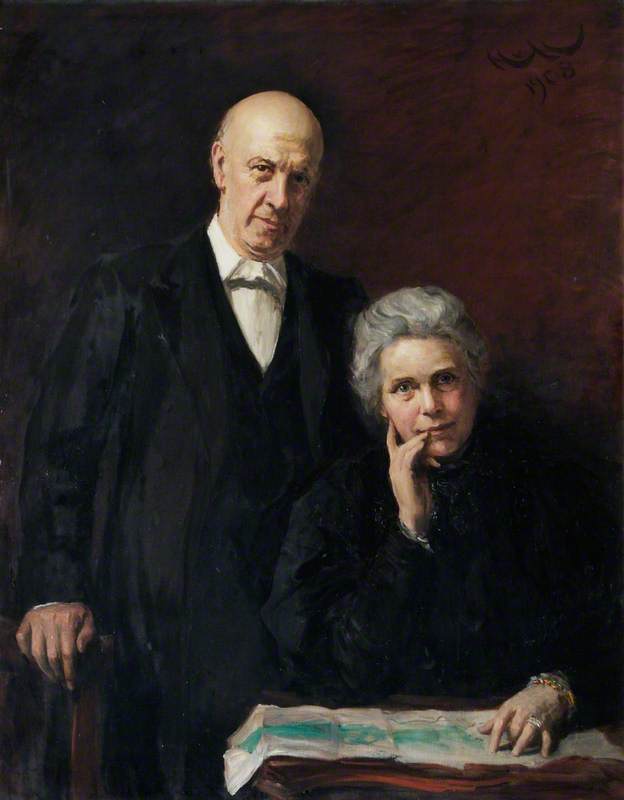
Henrietta Barnett (1851-1936)
Born in Clapham, London, on 4 May 1851, Henrietta was the youngest of eight children; her mother, Henriette Monica Margaretta Ditges Rowland, died shortly after her birth and her father, Alexander William Rowland (1808-1869), was a wealthy businessman who ran the family firm of Rowland's Macassar Hair Oil. Henrietta was educated at home but, at the age of 16, she spent three terms at a boarding-school run by the Haddon sisters in Dover. Following her father's death in 1869, she started to do volunteer work for Octavia Hill in the parish of St. Mary's, Bryanston Square, in Marylebone, London. This work, which consisted of managing homes for the poor, marked the beginning of her life of public service as a community organizer and social reformer, and of her relationship with Samuel Barnett.
Samuel Barnett (1844-1913)
Born in Bristol on 8 February 1844, Samuel was the eldest son of Francis Augustus Barnett, an iron manufacturer in Bristol, and his wife, Mary Gilmore Barnett, from a merchant family with a history in overseas shipping. Samuel was taught by a private tutor and attended Wadham College, Oxford (1862-6), before being ordained as a clergyman in the Church of England in 1868. Samuel was a curate and worker for Octavia Hill in the parish of St. Mary's, Bryanston Square, in Marylebone, London, where he met Henrietta Rowland.
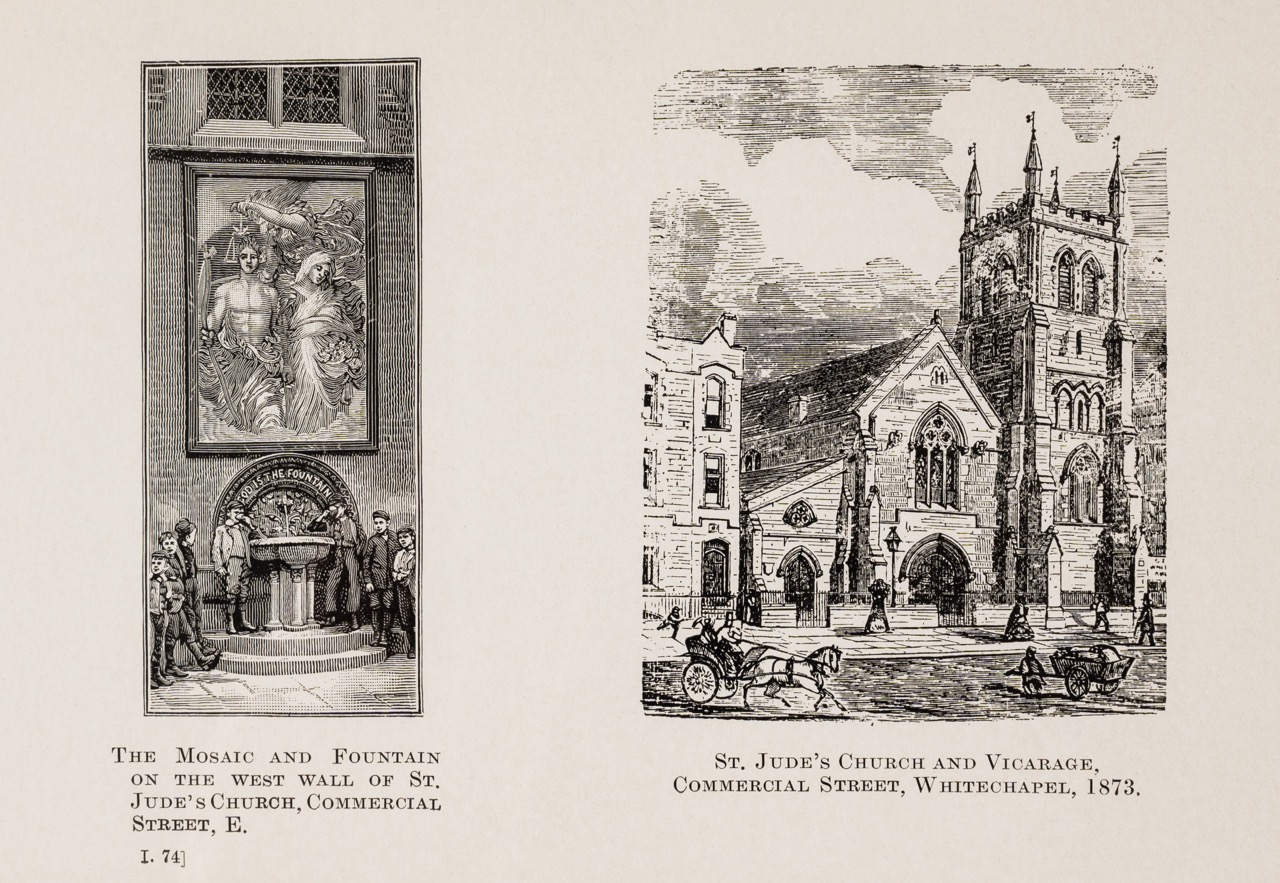
Samuel Barnett and Henrietta Rowland married on 28 January 1873 and moved to the parish of St. Jude's, Commercial Street, Whitechapel, in East London, in March 1873.
The Volunteers
The Exhibition relied on volunteers, parish workers, friends of the Barnetts, and Toynbee residents (usually undergraduate and graduate students from Oxford University). This volunteer army was large and organized into a general committee and a series of sub-committees with different responsibilities. The following descriptions of the committees from ‘Pictures for the People‘ reveal the amount of labor necessary to transform the school-rooms into an art exhibition:
- ‘The hanging committee undertook to measure the space, obtain the sizes of pictures, and see to strength of rods and thickness of walls.‘
- ‘To the general committee was left the duty of refusing undesirable-sized or inappropriate pictures.‘
- ‘The decorative committee made it its duty to provide hangings, flags, bunting--to hide the usual schoolroom suggestions, and to make the place attractive to the passing crowd.‘
- ‘The advertising committee undertook the difficult and expensive work of making the undertaking known, always difficult, but especially so when many of the people among whom the information has to be spread can neither read nor write.‘
- ‘The finance committee did the dull but necessary work connected with money.‘
- ‘The watch committee, whose work was the safeguarding of the loans, both by day and night. Policemen, firemen, and caretakers had to be engaged, not to mention the organization required to arrange for the eighteen or twenty gentlemen who came down daily to 'take a watch' of four hours in the rooms.‘
- ‘The work of borrowing was everyone's work; and, on the whole, the response met with has been generous, particularly from the artists and those owners whose possessions were few.‘
- ‘The cataloging and describing committee comes last; and its work, though done in a hurry, bore no slight relation to the success of the undertaking.‘
The Lenders
The list of lenders who sent their pictures to St. Jude’s is extensive and reveals a veritable who’s who of contemporary painters. In 1884, notable lenders included:
- Edward Armitage, R. A.
- Reverend Stopford A. Brooke
- Walter Crane
- Sir Charles Dilke
- Sir Julian Goldsmid
- Louisa Lady Goldsmid
- Sir Frederick Leighton, P. R. A.
- Earl of Rosebery
- Leslie Stephen
- George Frederic Watts, R. A.
The Artists
There were 150 artists named in the 1884 catalog, together with five described as ‘Artist Unknown,’ one as ‘An Indian Artist from Lahore,’ and one as from the ‘Dutch School.’ Of the named artists, there were ten works by Sir Frederic Leighton, President of the Royal Academy, nine by G. F. Watts, seven by Charles Napier Hemy, and four each by John Brett, Henry Darvall, and William Luson Thomas. Importantly, there were works by twenty female artists (approximately 13%) as follows in the order in which they appeared:
| Ellen Connolly | Cathinca Amyott | Henrietta Campbell Munro | Joanna Mary Wells |
| Annie Chaplin | Dorothy Tennant | Katherine Bruce | Kate Greenaway |
| Helen Thornycroft | Miss M. May | Ethel Munro | May Frances Munro |
| Constance Lawson | Gertrude Martineau | Alice Havers | Madame Jerichan |
| Marianne North | Helen Allingham | Miss Hewitt | May E. Williams |
Place
In the nineteenth century, East London, or the East End, was a place associated with immigration due to its proximity to the Docks in the Port of London and to Liverpool Street Station (formerly Bishopsgate Station) where people arrived from the Port of Harwich.
In the late 1880s, Whitechapel loomed large in the public imagination as the place where five women were murdered, between 31 August and 9 November 1888, by the serial killer known as Jack the Ripper. In the early 1880s, Whitechapel and East London more broadly were known as ‘Outcast London.’ largely due to the conditions of the poor. In The Bitter Cry of Outcast London, Andrew Mearns had exposed the alienation of the poor in the metropole in an account of the causes and consequences of poverty designed to stir moral outrage. The Bitter Cry was followed by George R. Sims’s ‘How the Poor Live’ and W. T. Stead’s ‘Is It Not Time?’ All these works were published in 1883, at the very time when Britain and other nations were embarking on a new phase of imperialism and when Eastern European and Russian Jewish refugees were fleeing religious persecution and economic hardship and settling in East London.
On 17 April 1886, Charles Booth held the first meeting to organize his groundbreaking survey of London: Inquiry into the Life and Labor of the People of London(1889-1903). Drawing on volunteers from and the resources of Toynbee Hall, Booth assembled a team of investigators for the purposes of quantifying poverty and misery in relation to wages, subsistence, and living conditions. The first volume, Labor and Life of the People. Volume I: East London (1889) was structured around narratives of class (part I), labor, (part II) and immigration (part III). There were four editions of Booth's survey, which was undertaken between 1886 and 1903 and which established a ‘line of poverty’ at an income of 18s. to 21s. per week.
The first versions of the Map Descriptive of London Poverty (1898-1899) were displayed at Toynbee Hall. There were 12 sheets in all; Sheet 5, East Central District, shows St. Jude's Church on Commercial Street.